On Training

When I started participating in Triathlons over 4 years ago, I did very little research on what to do for training. I knew that I needed to be able to swim, bike, and run the distances of the race, and consecutively. That of course is not hard to figure out, and the training plan in my mind had me building up to that capability. In training, I never ran more than a 5K, nor did I ever swim more than 800 meters. Those were the target distances for my first race, so why would I do more? I also did all of my training at full speed. Just run and train harder, and you will have lower times right? I would end workouts completely bonked and have a hard time remembering my computer password when logging back into my work computer. I also wanted to have a family friendly training plan. This meant that all training would be done at work during the hours we were given to exercise (cool job I know). Thus, I would try to cram as much into the allotted time I had and honestly, I still try to do that. Long hours away from family and associated responsibilities for a “hobby” no matter how obsessed I am, is just not justifiable (this is also one of the reasons I usually stick to shorter distances). That first triathlon was a “learning by hard knocks” experience, and the one I participated in later in that same year helped me to see that a different training approach could really increase speeds and performance. I saw this in the examples of others and in my lack of proper training. But what is proper training?  Here are some items I consider important (as of now) when implementing a training plan.

A Goal and a Date

This is rather self-explanatory, but I usually write or implement a training plan backwards from the date of the event I have scheduled.   For example, if I do a sprint on the first weekend of June, my build will come to a sprint specified crescendo on the third weekend of May. If you subscribe to a training plan, download one, have a coach, or make it up yourself, the goal and a date question will be the first one to answer. That being said, I usually set up my whole season’s schedule in December or January with two or three “for sure” races, and then fill the rest in with tentative ones as the time comes closer.

Workload and Recovery

The next question I answer with my training plan is how much time I want to put in during each week, and when can I find the time to do the training. While the kids sleep or during work hours is the first option, and second option becomes “when it best suits the family”. Last option and least favorite is, “I know that is your fifth time changing a diaper today, and you are tired of the kids, but I will only be gone an hour”. Sometimes I will skip the workout to assuage matters on the home front, but that is to each athlete’s discretion.   Priorities are important and as doing triathlons is a hobby, I can skip a workout and not suffer monetarily like professionals might.

Recovery is something that I am just learning more about, and people like Joe Friel have written novels on the topic.  With my limited knowledge, I do know that recovery days, weeks, and months need to be implemented into your training calendar.  I usually take a recovery day after a hard workout, and sometimes two.  I also try to implement a recovery week every month.   For example if my usual workload is around 6-8 hours a week, on the 4th week I will only put in 3-5 hours.  You can really feel the difference those weeks too.  It is hard to hold back and you get antsy, but for me it makes a great difference.

Training breakdown as per sport.

Training breakdown as per sport.

Intensity

Simplistic and concise: every workout should follow a specific intensity level.  This may be either according to heart rate, power, perceived intensity or smiley/frowney faces.  Training all out on every workout is dangerous and draining.  This simple guideline makes a world of difference in the smiley and frowney faces after each workout is over.

Documentation

A place to go in order to view all of your data is for me a very important part of training.  This documentation as an overall picture will help with governing your workload.  It is also a neat thing to be able to say that you have decreased your mile/kilometer time by 10 seconds over the past 3 months.  Without some form documentation you might not be able to do that.  This documentation will also help you with your future scheduling of workload and recovery.  When I started out I used a spreadsheet and kept track of things that I thought were important. I still use a spreadsheet, but now, however, because I use GPS devices, the online data collection interfaces are my go to sources for documenting my training.  People differ on opinions of which company does the data best, but I won’t debate that here (I don’t really know either).

Variation

I go stir crazy in the winter on treadmills and the trainer, but I try to combat this with movies, different gyms, intervals, fartleks, and cross training whenever I can.  Even during the summer months I have found it important to not run/ride/swim on the same outdoor course day after day.  Cycling is a little more limited to the same few courses because road bikes are finicky with where they are willing to ride, but exploratory running is very important to keep me entertained.  When I am entertained, I think less about the pain.  Variation with your workload during your workouts is also important for muscle memory and recovery.  In other words, no more all out sessions every time.
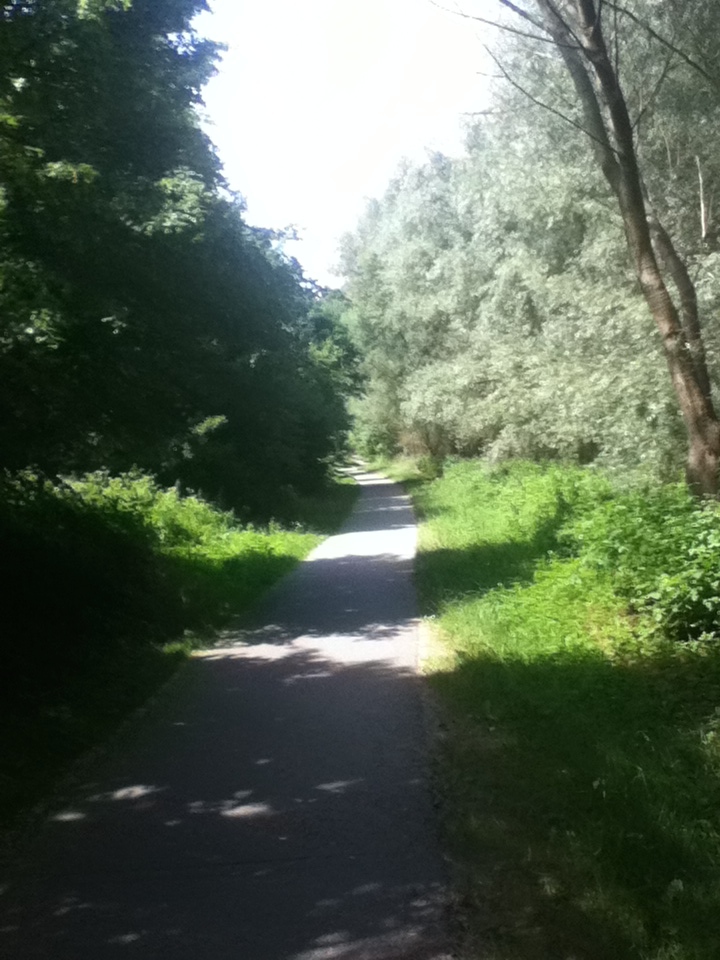
IMG_0836

One of the many running paths I frequent.

Priorities

If you have noticed within this post that I have made sure I listed triathlon as a hobby.  I need to continually remind myself that.  When I have that in mind this keeps my priorities in control.  Obviously with it as just a hobby, family life is more important, but sometimes during peak triathlon season it doesn’t seem like that as the family takes a back seat.  Putting family first does not include leaving them for 6 hours on a Saturday so that a specific race can be experienced.  However, it can become a very fun family activity if your wife or significant other is up to attending with the kids in tow.  Some of my favorite triathlon experiences are when my family is at the finishing line, or somewhere on the course to cheer me on.

The above categories are the ones I currently consider important regarding training for triathlons.  By following these guidelines training for me has become an enjoyable thing and oddly enough something to look forward to on a daily basis.

Ipf-Reis Halbmarathon 2014

Build Up and Arrival

On May 10th, 2014 I completed my first half marathon.  I had always said that people were not smart if they ran for that long at any given time, but it seemed like the next step in my triathlon training if I ever wanted to complete a 70.3.  Thus, I found one in my area at the first of the season, and adhered pretty well to a half marathon training schedule after completing the 320 kilometer Brevet.  As previously mentioned, most races here in Germany take place in the afternoon.  This has advantages and disadvantages.  One of the disadvantages is that you have all day to think about the fact that you have to run 21 kilometers.

The packet pick up for this event was a few hours before and took place in Noerdlingen.  The packet was actually a draw string backpack.  I enjoy it when races actually give useful items.  After picking up the packet I wandered around Noerdlingen while my boys napped in the car with my wife.  I started to get a little hungry and purchased a little pastry in the city center.  One of my favorite things about doing events here in Germany is seeing the different little cities that I would otherwise not visit.  Noerdlingen falls into that category, and was a quaint little city with a nice city center and a circumferential wall.  Pretty cool.

Goals

This half would of course be the longest distance I had ever run, and my goals developed into 4 fold over the course of my training.

  1. Finish
  2. Sub 2:00:00
  3. Sub 1:52:00
  4. Sub 1:50:00

The long runs of my training had ramped all the way up to a time of 1:45:00, and though at that slower long-run-pace, I only covered 17 kilometers, I felt pretty confident going into the race for the first goal.  I had also barely received the Garmin fenix2 in the mail 2 days prior and set a virtual partner pace at 5:13 min/km.  If I kept that pace I would be able to make it across the line sub 1:52:00 thereby meeting  Goals 2 and 3.  Goal 4 would be the driver for me during the run.  Basically I knew I needed to get at least 2 minutes ahead of the partner, and then I would meet Goal 4.

The Course

Noerdlingen is located a little over an hour to the West and North of Ingolstadt.  This proximity was the main reason I chose this race.  During preparations, I had mapped the course out and looked at the profile and noticed with slight disappointment to see slightly over 125 meters of elevation gain in the 21 kilometers.  Other than that, the meandering course seemed to be fairly pleasant and made sure to visit the small villages along the way.  Running in Germany is overall a pleasant experience because of the numerous bike paths and well developed access roads that meander through fields and villages.

IPF-Ries Halbmarathon

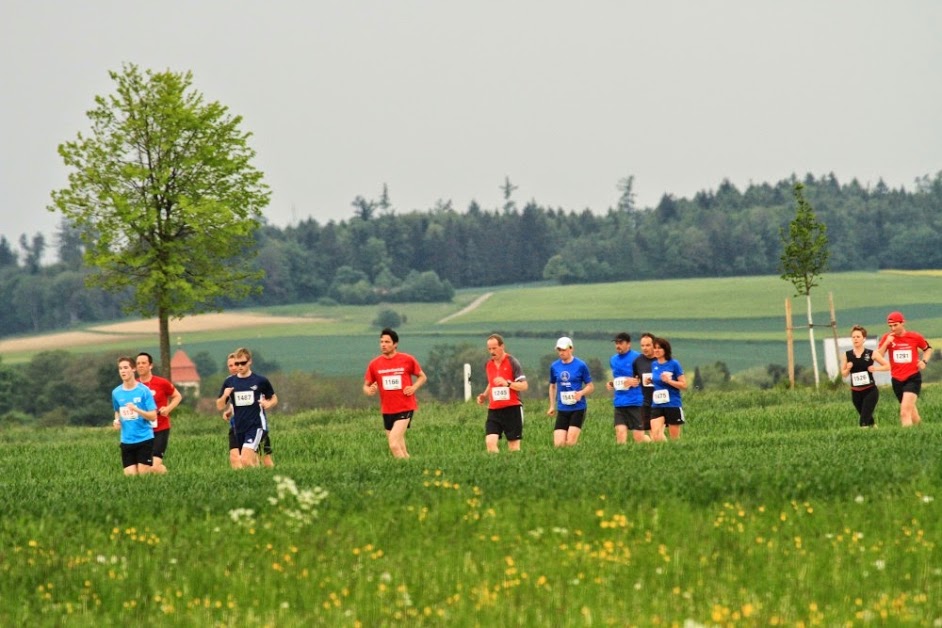
Meandering course between Nordlingen and Bopfingen.

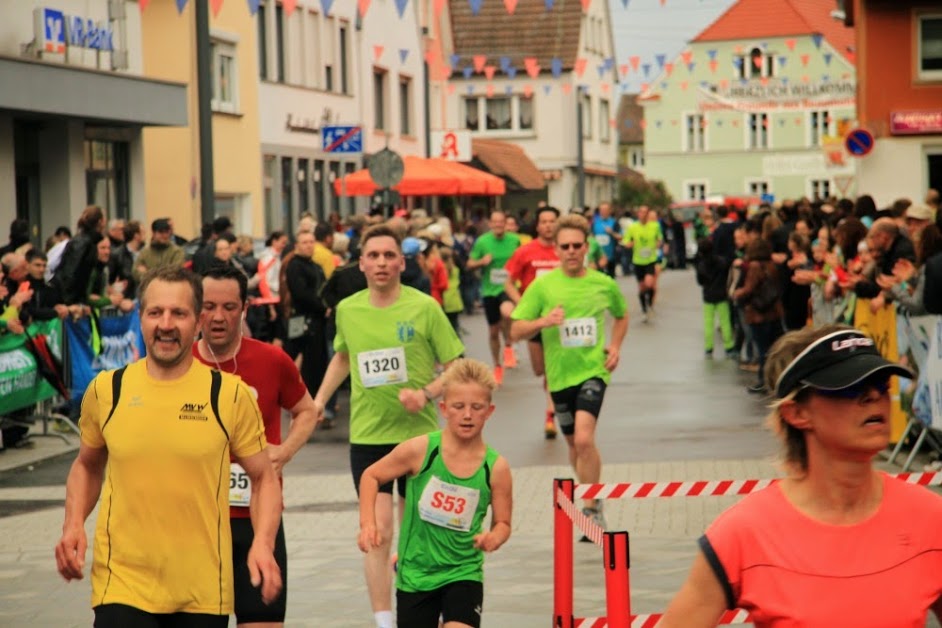
Excuse me, coming through!

Excuse me, coming through!

The Beginning

After looking around the city center, I went back to the starting area, met up with my family, and then eventually to the starting line.  After finding my appropriate group of runners with which to run (just under 2 hour pace), we listened to music and waited until the bullhorn.

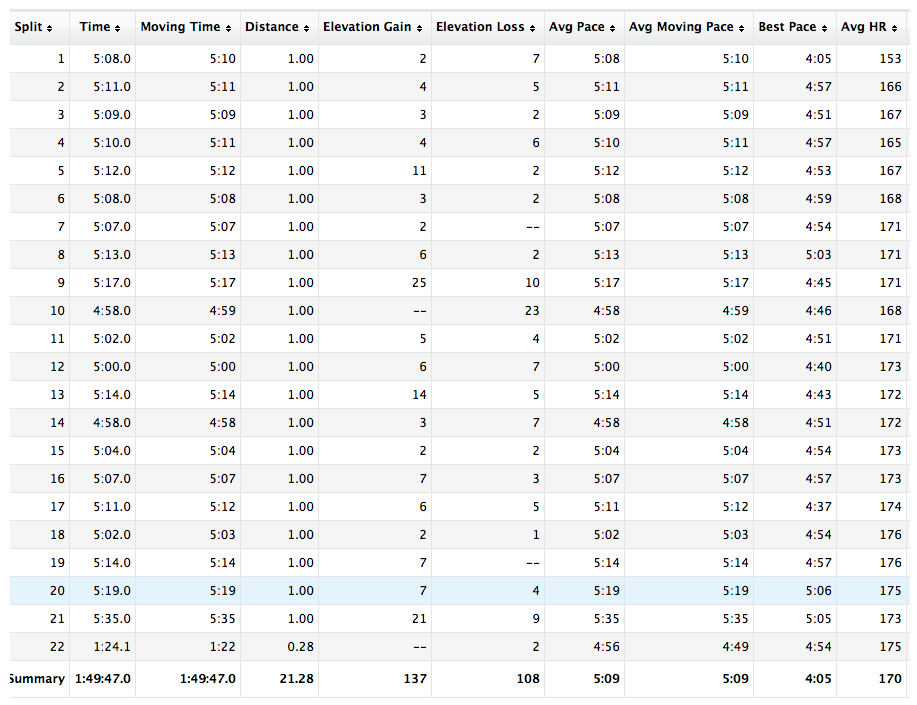
The first of the race was a elbow and slalloming session, but I am pretty used to that by now.  As part of my race plan I wanted to get warmed up slowly and assure my HR didn’t spike too high within the first 5K.  After the first kilometer I got an autolap alert from the watch telling me that I was at a 5:08 min/km pace, and that was right where I wanted to be.  My HR was still in Zone 2, and all things were looking good.  I found a pacer and stuck along side for the next kilometer (5:11).  My HR was now into Zone 3, and I was pleased that the first 2 km had gone by so quickly.  Around this point I saw a shirt of a competitor that was written in English, so I asked him if he was American.  He responded with a thick Australian accent that he was German but had played soccer in Australia for 7 years.  It was really interesting to hear a German with an Australian accent.  He was the best english speaking German I have met to date.  He was also easy to pace with, though he ran like a soccer player.

Aussie Aussie Aussie!

Aussie Aussie Aussie!

We chatted for awhile, and then he said that he should be running and not talking, so we stopped talking.  We stayed together for quite awhile and dealt with wind around kilometer 7 and rain around kilometer 9.  The temperature dropped rather quickly before and during the rain, and I was worried that I wasn’t dressed well enough.  During the heaviest part of the rain, was the steepest uphill portion of the run.  That was not fun.  My pace slowed to 5:17.

The Middle

Then suddenly, the rain stopped, and a slight decline helped my pace and the emerging sun made me quite happy.  My split was at 4:58, and I noticed that I had lost my Aussie German friend.  I was now passing people with more frequency and I started wondering if I was going too fast so I monitored my HR for the next few kilometers to assure I was still within mid to low Zone 4.  Things were feeling really good though and I developed a Pac-man style of running.  Slightly increasing my speed occasionally to catch the next person ahead of me.  Around kilometer 13 I started noticing the exhaustion (lactic acid) entering into my muscles and wondered how much longer it would be before I hit the wall.  The music on the iPod helped drown out the negative internal voices, and the spectators in each village were awesome.  At each aid station I managed to swallow a banana and a little bit of water.  I was impressed how much the banana helped.  It was just really hard to eat it on the run.  I need to practice that I guess.

Playing pac man at this point.

Playing pac-man at this point.

Where is the End?

Running with kilometers instead of miles seems to make the race shorter.  Obviously this is not the case, but if you think about it in terms of intermediary goals, 21 achievements is much more fulfilling than 13.  It is also easy when you run at my pace to figure out how much longer you will be running.   Around kilometer 17 I was waiting for anything resembling a finish line.  My pace dropped below 5:10, and I decided to see if I could push it harder.  I could only dial it up a little more during the next kilometer and then noticed the finish line in the distance.   Uphill?  Not much, but enough to make me tired.  My pace suffered, and my legs  started screaming at me and refusing to move faster.  Around this time I heard honking and my wife drove by with the windows down and screaming encouragement.  This meant she would not be able to park the car and get to the finish line in time to see me, but the boost was worth it to me.  One thing that I had never seen before in a race was Coke being handed out at kilometer 20.  Pretty interesting, and though every one else was drinking it very enthusiastically, I was not in the mood to vomit.

The End

Entering Bopfingen was relieving and yet I knew that last 0.1 kilometers were still left.  I picked up the pace as the terrain leveled and as best I could tried to pick off a few of the people that had past me in the previous 2 kilometers of slower running.

In crossing the finish line I failed to stop my watch with the first and second button push.  On the third it worked, and I noticed the time of 1:49:47.  I actually attempted a shout of jubilee, but it was barely audible.  I had achieved all goals.  I was toast too.  This was a great feeling.  The waves of endorphins started rolling in and came with consistent frequency and duration.  Those alone make it understandable why people do these longer distances.  I downed a few glasses of the liquids they were handing out and then started looking for the wife and boys.  I was ready to go home, and interestingly enough didn’t want to bask in the finishing line euphoria for long.   I had finished my first half.  The only question now is if I could do this distance after swimming and biking.  We shall see…

IMG_1753

Looking down to push that Stop button… Finally!

Screen Shot 2014-05-26 at 9.47.41 PM Data Upheaval 

One benefit of running with the fenix2 was the large amounts of data obtainable for scrutiny.  Sometimes I spend more time looking over this data than I did doing the race.  Definitely loved the new fenix2 for running.  I enjoy the running specific statistics too, just need to figure out what to do with them and how to incorporate them into training.  Onwards we go with the learning.

More detail than you care to read about.

More detail than you care to read about.


The welcoming party!

The welcoming party!