
Lead Up & Arrival
I had chosen this triathlon back in January for a few reasons. Proximity to house, lower price, Saturday race, and it was a sprint. I signed up, submitted my entrance fee, and then succinctly forgot about it. Having another baby join the family can place other things on the back shelves in your mind. My training plans were also focused on an Olympic in August, and a 70.3 in September, so I didn’t do my normal sprint specified crescendo leading up to this race. All that said, I was ready for this race, and it was a good first triathlon of the season test for me. Quite a fun race actually, and highly commendable.
Upon arriving at the race location, the first thing I noticed were the expensive bikes rolling to transition accompanied by skinny, tall, cut, men and women. Now, I have long been accustomed to feeling inferior to most triathletes because I am slow, a little hefty, and I use inferior equipment. This however, was a different feeling. Maybe it was because they were all speaking German which is an intimidating language by itself. I decided at that point, that I wasn’t going to luck into any age group podium spot. Sometimes you just know by looking at people who within their legs resides slow twitch muscles capable of 300 Watts and 3:30 km/min paces. I resolved then to simply focus on my own race plan.

Race plan! yes, I am nerdy!
Check-in
After reassembling the bike and the 3 tiered stroller, I went over the check in area. Germans have a hard time with my name. They never know which is my first or last name. I usually need to explain it two or three times. After name bingo, the handed me what to date is the most minimalistic race packet ever. It included: my race bib. That’s right, nothing else. No timing chip, no batch of flyers for races or sports companies around the area, just my number.
Briefing
Thirty minutes before the start of the race, the director got on a PA system and informed us of the rules and specificities of this race. They had moved the start time back 10 minutes to hopefully not interfere with a scheduled train on the tracks we were to cross. One detail he mentioned with this race was that because the water temperature had reached 22 degrees Celsius, wetsuits would be verboten.
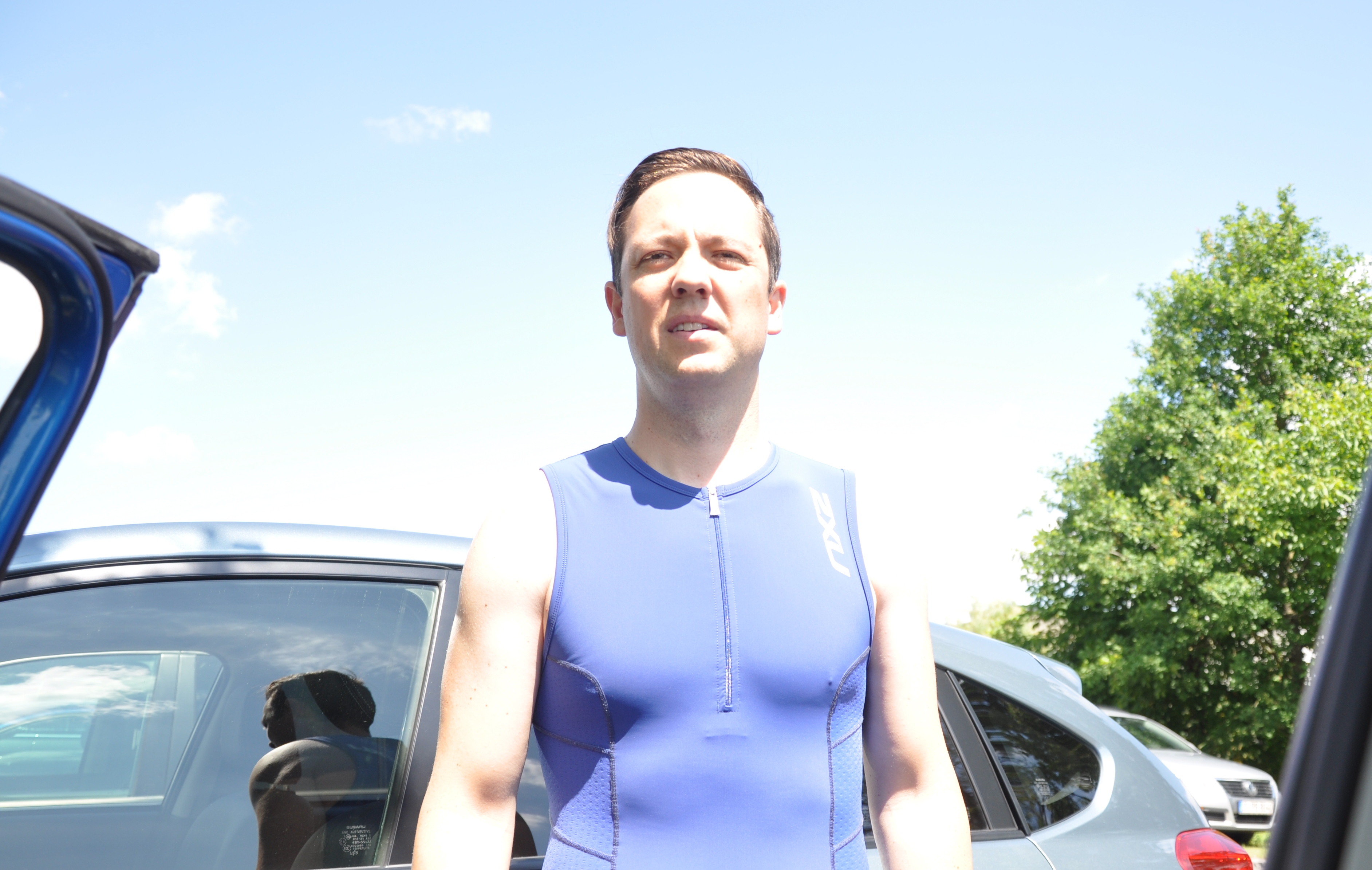
Ready to race sans wetsuit.
Swim
After the few minutes of briefing and a welcoming from the mayor we were given a little more time for preparation. Shortly thereafter, most of the athletes slowly made their way to the swim start. The race director assured that only the first wave of athletes were in the starting area, and then let us know the minutes remaining with a periodic announced count down. It is funny that no matter where you race, the same feeling is experienced by the athletes. I heard one man say what I have thought many times during this final countdown. “Why am I standing here?” This thought usually stems from the knowledge of what could go wrong. Be this cramping, side aches, component failure, crashing, or any other injury. It also stems from mans desire to be at rest. This man is the one that is truly screaming during the countdown, “Why am I standing here?” That voice has gotten quieter for me over the years, but regardless of the distance to be raced, it is still present.
Due to the low-level of the water in the pond, after the gun was shot, we had to wade a long way into the pond before swimming was possible. The path was a triangle with 2 left turns around 2 buoys. During the first stretch I sighted every 10-15 strokes and noticed that while I was taking a fairly straight course to the buoy. Most everybody else was out wide. Maybe they wanted to curve the turn? I wanted to swim the shortest distance possible so I stayed my line. After the buoy a short 50 m took the swim path under a foot bridge. The water was again very low here, so I ran in the knee-deep warmer water for about 25 m. Another 50 m and the 2nd buoy was circumnavigated whilst receiving a few teeth kicks. Somewhere on the stretch back to the start my pace really suffered. I don’t know exactly why, but sighting was also needed more frequently. It was in this stretch that I noticed 1 or 2 people from the 2nd wave swimming gracefully passed me. I really wish I could swim like those people. Finally I arrived in the area where I could stand up and wade to shore. When I pushed lap on my watch I noticed 11+ minutes (crap!) – I was already behind my goal pace. I’d have to make up that time on the bike.
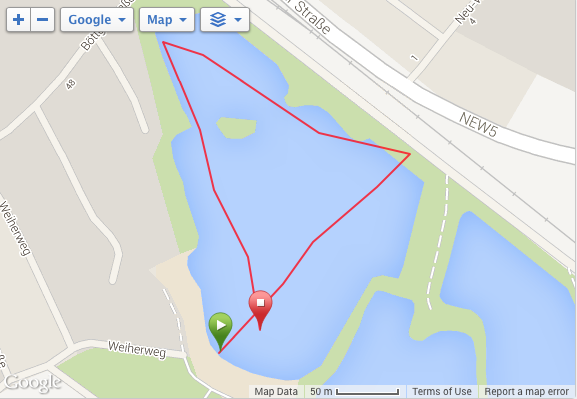
Swim path as mapped by fenix 2.

Swim splits per fenix 2.
T1
The transition went as smoothly as last year’s sprint in Virginia although it took longer than I wanted. Putting socks on wet feet is difficult. I decided that for sprints, I wouldn’t worry about bike shoes (or cleats) during the bike. This doesn’t make T1 faster, but T2 is lightning quick. Riding in cages is also very easy for me to adjust to quickly. It puts more strain on your calves, but that is fine, too. One issue I had in transition was the bike computer. It had turned off and took a bit to turn back on. I didn’t wait for it, but instead pushed it while running. (note to self: extend computer sleep time)
Bike
One brilliant idea I had while waiting for the race to start was to set up a data page on my bike computer with only AVG SPEED, HR and CADENCE. I had already set the auto lap at 1 km, so updates on my current pace were frequent, but my driver and goals were set up with AVG SPEED for the whole course. I also needed to know where my HR was, and if possible keep it above 165 but below 180. Cadence was just a filler that would tell me he stupid you can shift now if my body hadn’t informed me already. Hopping on the bike went fine, and I found myself in a small pack of about 5 riders. Since my HR was already in the zone I wanted, it didn’t take me long to find the groove, and get my speed up. The first 2 km were rather flat, and the AVG SPEED jumped all the way to 37 km/h. Those were the last flat km on the course. I hadn’t really looked at the elevation profile with too much scrutiny beforehand, and maybe it was better that way. Climbing is not an issue for me, but your overall pace suffers and you never get it all back. During the course there were 2 extended climbs that were small chainring climbs for me. However, my thoughts and hopes were what goes up must come down, and I was looking forward to some high speeds while in the aero position on coming back down. There were some good descents in the middle of the course but they were immediately followed by more hills. I watched my AVG SPEED vary as low as 20 km/h and reach back up to 34 km/h. Usually the bike portion is where I pass most of the people within reach. This wasn’t the case on this race. Everyone was fast on the bike, and while I was only passed twice (both on downhills by tri bikes with aero helmets), I ended up only passing 4 people. That was really interesting to me. As assumed, the expensive bikes weren’t just for show. These guys and gals were good. After the last extended climb, I knew that there couldn’t be anymore significant climbs because I was getting close to the end of the bike leg. I stuck myself in the aero, and worked on getting the average speed back up as close to 33 as possible (my goal). It slowly climbed to 31.8 and I then made the final turns to get back to transition. Overall not bad, but as I said hills never give back fully.
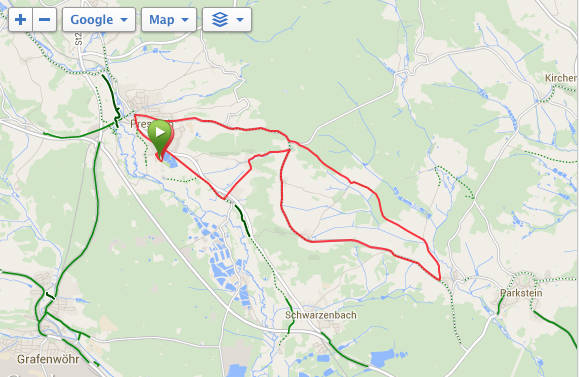
Bike portion as mapped by Edge 500.

Elevation profile of hilly bike portion.

Summary of bike as per Edge 500.
T2
Getting off the bike I felt good, and I hung my bike quickly and took off my helmet. I pushed lap late, but overall, I think I was in the transition area for 15 seconds. That short T2 brought the average of the 2 transitions to just under 1 minute; exactly what I was looking for.
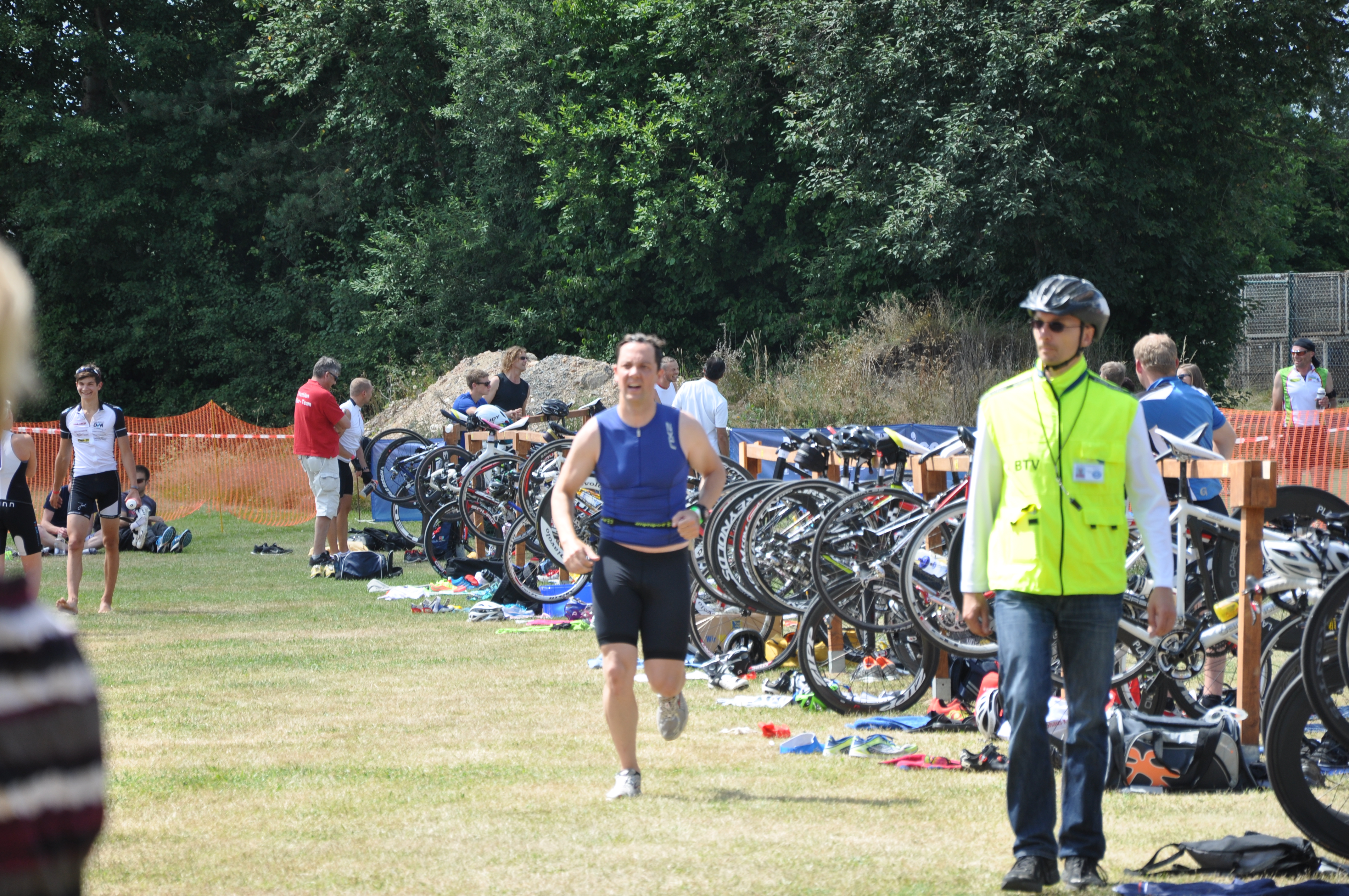
Coming out of T2. A lot of bikes are already hanging.
Run
As I started the run, I saw my small family just outside the transition area. That is always a boost for me. Another 30 minutes and I could play with the boys on the slide I saw. As I was running out of T2 I heard the race director tell me to turn my number bib around to my stomach over the PA system. As I did this, the bib broke/ripped off my belt. Thus I spent the first km trying to figure out how to get my number to stay in place on my stomach. After that problem was solved, I looked down at my pace and noticed I was exactly where I wanted to be; 5:02 for the first km. I started running alongside the guy that I had followed on the bike for most of the way. We talked briefly about the hilly bike, and then he said, “Oh, save your strength for the hills on the run.” Hills here too? Awesome! I thought. The first hill took my HR up to the 180’s and I needed 500 m to get it back down to where I wanted it. At this point I decided perceived effort was to be my guidance along with pace. The 3rd km was the fastest, and I felt he best during it, too. There was a downhill section and I let my legs go as much as I could. There was another climb during the 4th km and it almost brought me to a walk. I passed a few people during the run, and was passed twice by real runners. At the top of the second hill, there was another aid station, and the lady handing out water said that it was all downhill from there. “Yeah, I figured.” As soon as my HR steadied, I attempted to shorten my stride and pick up the pace. I got it to a 4:30 min/km pace around the 5 km mark, and then felt what I feared I would: knee pain. I had to dial it back, and I was mad and slightly depressed.
I had been stretching and resting my knee for the whole previous week (Runners Knee symptoms), so I was a little disappointed that what I had done didn’t help. As soon as I had this thought however, the pains went away and in actuality hadn’t really even started to hurt too bad. Then the hill we ran up at the first was descended, and less than 1 km remained. I picked up the pace as high as I dared (and could), and closed the gap between myself and the two people I had been chasing. Because timing clips weren’t being used, you couldn’t pass within the last 200 m, so I ran behind this man and woman to the finish. The race director made a big deal about me crossing the finish, and attempted a few words of congratulations in English. My name is definitely American.
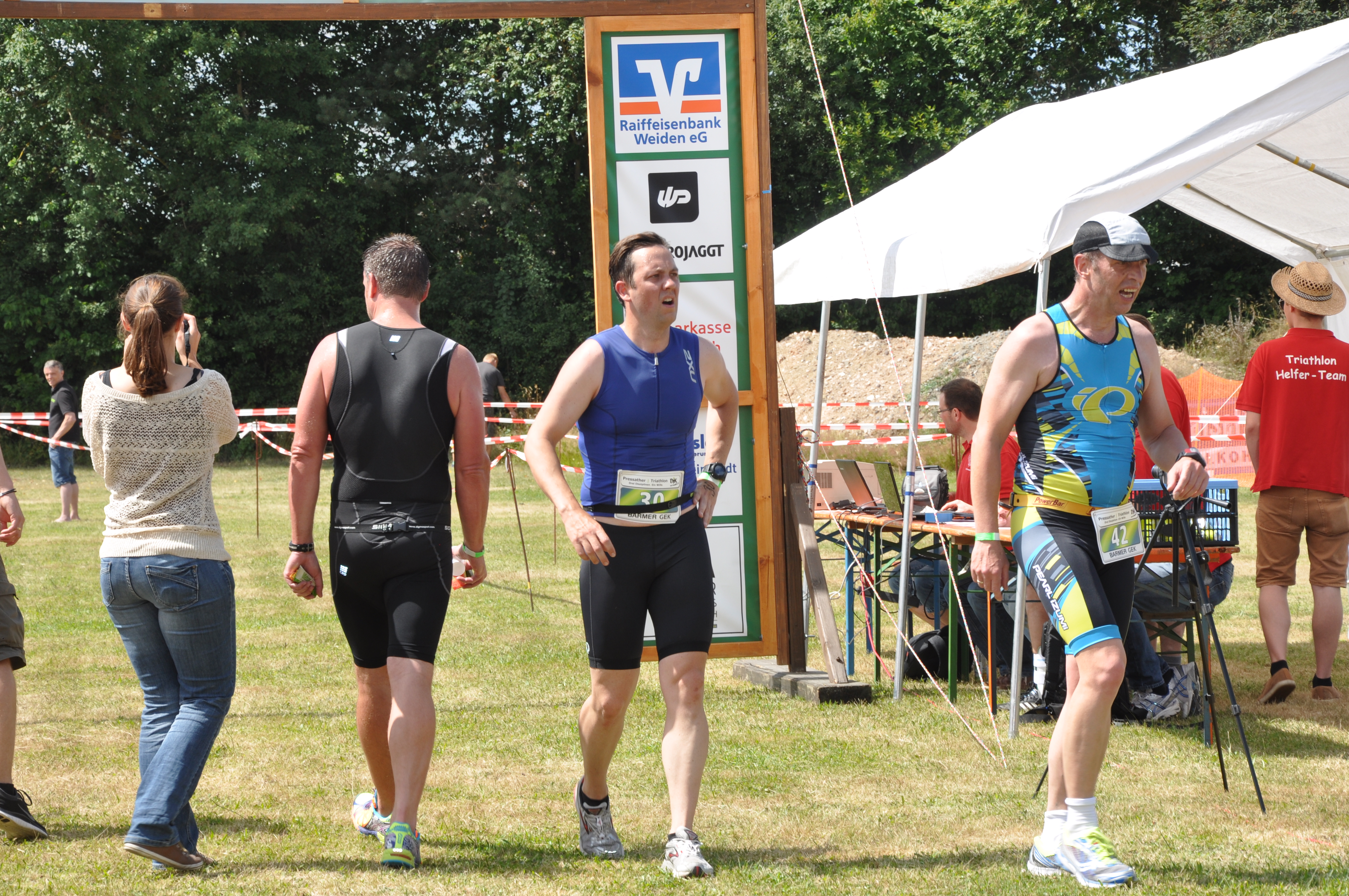
I need to work on my “I’m happy I just crossed the finish line” face.
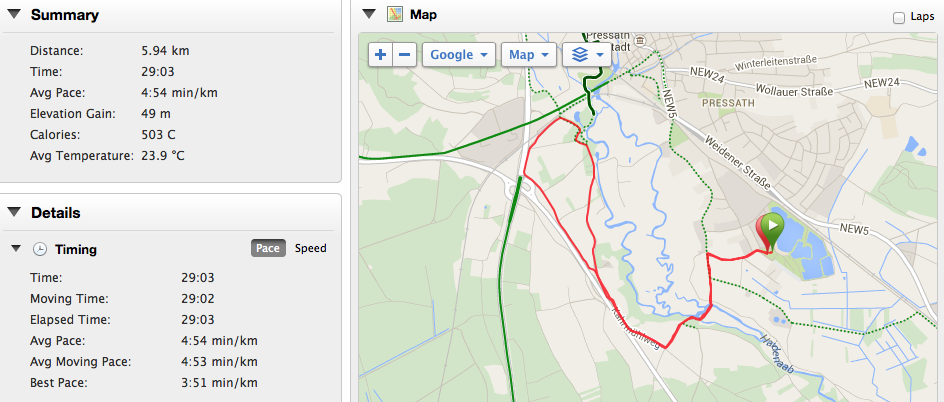
Run map and summary data as per fenix 2.
Thoughts & Take-aways
This was a fun race, and were I here next year at this time, I would do it again. Though hilly, it is a good test for training. In fact, most of the top ten finishers were professional triathletes. They do this race because it is a really good workout. Lessons learned included bib preparation, or maybe another bib belt. I really like the data page I set up before this race, and will use it again (but maybe without cadence). Pushing the lap button at the right time is necessary for proper data accumulation. Finally, I reaffirmed my belief in using running shoes and cages for sprints. Thanks for stopping by.

This little man’s first triathlon. He was ambivalent.

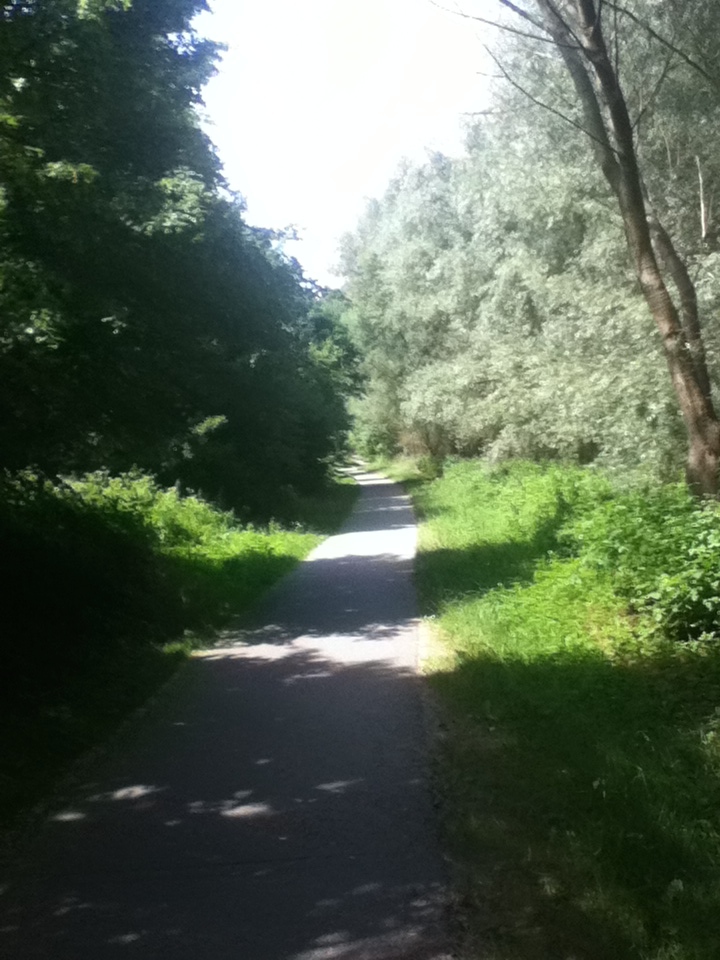
 brothersenroute